Worldwide, Chardonnay is one of the most important white wine grape varieties. Especially in the New World, the grape – which belongs to the Burgundy family – is widely cultivated. The famous Chablis wines from France are also made exclusively from Chardonnay.
In Germany, Chardonnay has become increasingly widespread in viticulture since its official approval in 1994. German Chardonnay wines are still comparatively little known internationally.
With their delicate fruit and freshness, Chardonnay wines are wonderfully versatile food companions that do not push themselves to the foreground in terms of flavour.
Chardonnay white wine pairs excellently with grilled or roasted poultry, vegetarian dishes, pasta as well as fish and seafood.
Chardonnay Vineyard Site at Weingut Fuchs
The Chardonnay at Weingut Fuchs grows in the vineyard site “Dalsheimer Bürgel” in Flörsheim-Dalsheim in Rheinhessen. On calcareous, deep soils and in gently hilly terrain with a slight south-eastern slope, the variety finds ideal conditions that allow the grapes to reach very good ripeness.
Facts About the Chardonnay White Wine Variety
Origin of Chardonnay
The origin of this old white wine variety lies in Burgundy. Chardonnay developed from a natural crossing of the grape variety Gouais Blanc (Weißer Heunisch) and a member of the Pinot (Burgundy) family. Due to the very small genetic differences between the various Pinot varieties, it is still not possible to determine exactly which one was involved. Because of its Pinot parentage, Chardonnay is classified as part of the Burgundy family.
From Burgundy, Chardonnay spread throughout Europe and later across the world. Today it is one of the most widely planted white wine grape varieties worldwide.
Characteristics of the White Wine Variety Chardonnay
Chardonnay has similarly high demands on site and soil as Pinot Blanc or Riesling. The variety thrives best on warm, deep and calcareous soils.
Chardonnay shows good winter hardiness. The vines require sufficient space in the vineyard with wide planting distances and higher trunks.
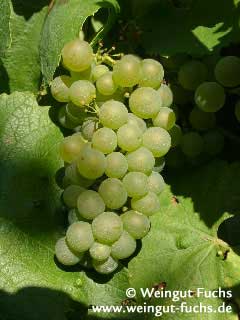
The bunches are small and compact. The thin-skinned, amber-coloured berries ripen comparatively late, can reach high must weights and bring a balanced level of acidity.
Price per bottle (0.75 l) incl. 19% VAT plus shipping fees
FAQ – Frequently Asked Questions about the Grape Variety Chardonnay
Is Chardonnay always a dry wine?
At Weingut Fuchs, Chardonnay is vinified in a dry style. In principle, off-dry or sweet styles would also be possible. However, due to the flavour profile of the variety, dry vinification is particularly suitable.
What does Chardonnay taste like?
Typical Chardonnay wines show delicate fruit aromas such as apple, pear or citrus. Depending on the vinification, notes of nut, butter or vanilla may also occur. On the palate, Chardonnay usually appears harmonious, balanced and well structured.
Does Chardonnay pair better with fish or with meat?
Chardonnay is a very versatile food companion. It pairs well with fish and seafood as well as with poultry and light meats, pasta and vegetarian dishes.
Why is Chardonnay considered an international grape variety?
Today, Chardonnay is cultivated in almost all major wine regions of the world. The variety adapts well to different climatic conditions and produces very different styles depending on its origin.